
ChatGPT and the Sigmoid Curve: Where are we now?
March 13, 2023•1,120 words
The adoption rate of ChatGPT has accelerated rapidly since late 2022. I don't believe I have consciously been aware of such a rapid uptake of a new technology in my lifetime. The World Wide Web certainly, but I took this for granted and grew up alongside it. The development that I was most aware of would be the development of Google search in the late 1990s and the subsequent explosion in popularity in the years that followed. Growing up, I was lucky enough to use Microsoft Encarta to find information for school projects, and eventually saw Google emerge as the search engine as Yahoo faded into obscurity. The explosion in the popularity of Google search, as we now know, led to the verbification of the word "Google". How long until we get there with ChatGPT (or its competitors)?
Like all new useful technologies, the adoption follows a predictable pattern. Firstly, the early adopters grasp the new technology – these are the people that generally jump on any new or exciting developments in the field. Over time, word of the technology spreads and more people adopt the technology. Eventually, either the innovation stagnates, or the market becomes saturated, and the adoption rate slows as a larger portion of the population have now have access to the technology.
This process always follows the same pattern. Plotting the adoption over time will always yield a sigmoid curve. Everett Rogers described this phenomenon in his book Diffusion of Innovations. Rogers uses the term “diffusion” to describe how a new innovation or technology is communicated over time among participants in a social system (or how the innovation spreads through society).
I saw mention recently of how fast the user base of ChatGPT had grown in such a short amount of time. In only a couple of months, ChatGPT went from a relatively obscure open access demonstration from OpenAI into a worldwide phenomenon with over 100 million users. This is staggering when you consider how long it has taken other web-based innovations to thrive. In the image below, I have plotted how long it has taken some of these companies/apps to reach 100 million users. Originally, I wanted to compare how long it took to get to one million first, but as we get closer to the present, the one million user mark has become only a blip and not even worth noting. Perhaps this is just due to our insatiability for new and better things, but I still think the comparison is worth making: Google took less than a year to reach the one million user mark – it took ChatGPT less than a week.
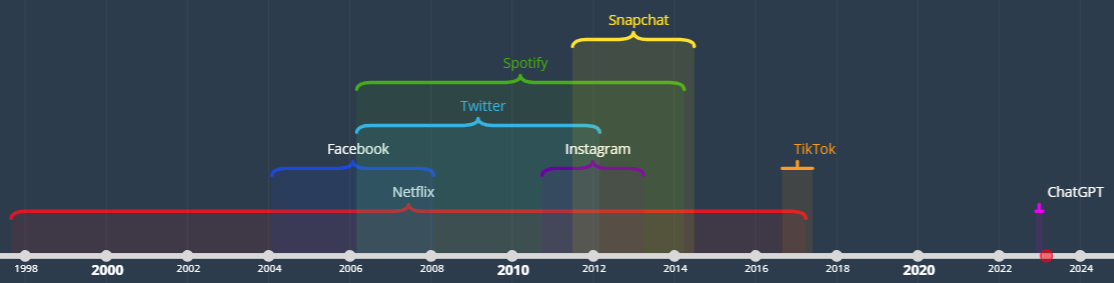 The time taken for some popular products/technologies to reach 100 million users. As we get closer to the present, the time taken to get to 100 million users has reduced considerably.
ChatGPT is only a blip on this time scale. Yet there is now an even smaller, and potentially more disruptive blip: Microsoft's Bing. Microsoft’s Bing-integrated ChatGPT variant reached 1 million sign-ups in less than 48 hours since its announcement. Only a few days ago (March 10, 2023), Microsoft has just announced that Bing has over 100 million daily users – numbers driven mostly by the including of the new AI-powered chat features. With the promise of this new technology being incorporated into the rest of Microsoft's productive suite, the numbers will grow absolutely exponentially in the coming months, I am sure.
Why talk about these time scales though? What do sigmoid curves and adoption rates have to do with these innovations? It would have been impossible during the early days of the World Wide Web to predict just how disruptive it would be. Early criticisms and predictions in the mid 1990s included the fact that it would collapse and cease to be relevant within only a few years. Robert Metcalfe in 1995 predicted that "the Internet will soon go spectacularly supernova and in 1996 catastrophically collapse." That same year, Waring Partridge stated that "Most things that succeed don’t require retraining 250 million people.” Yet now there over 5.16 billion people using the web as of January 2023. There would have been no way of knowing that we were still only at the beginning of that sigmoid curve.
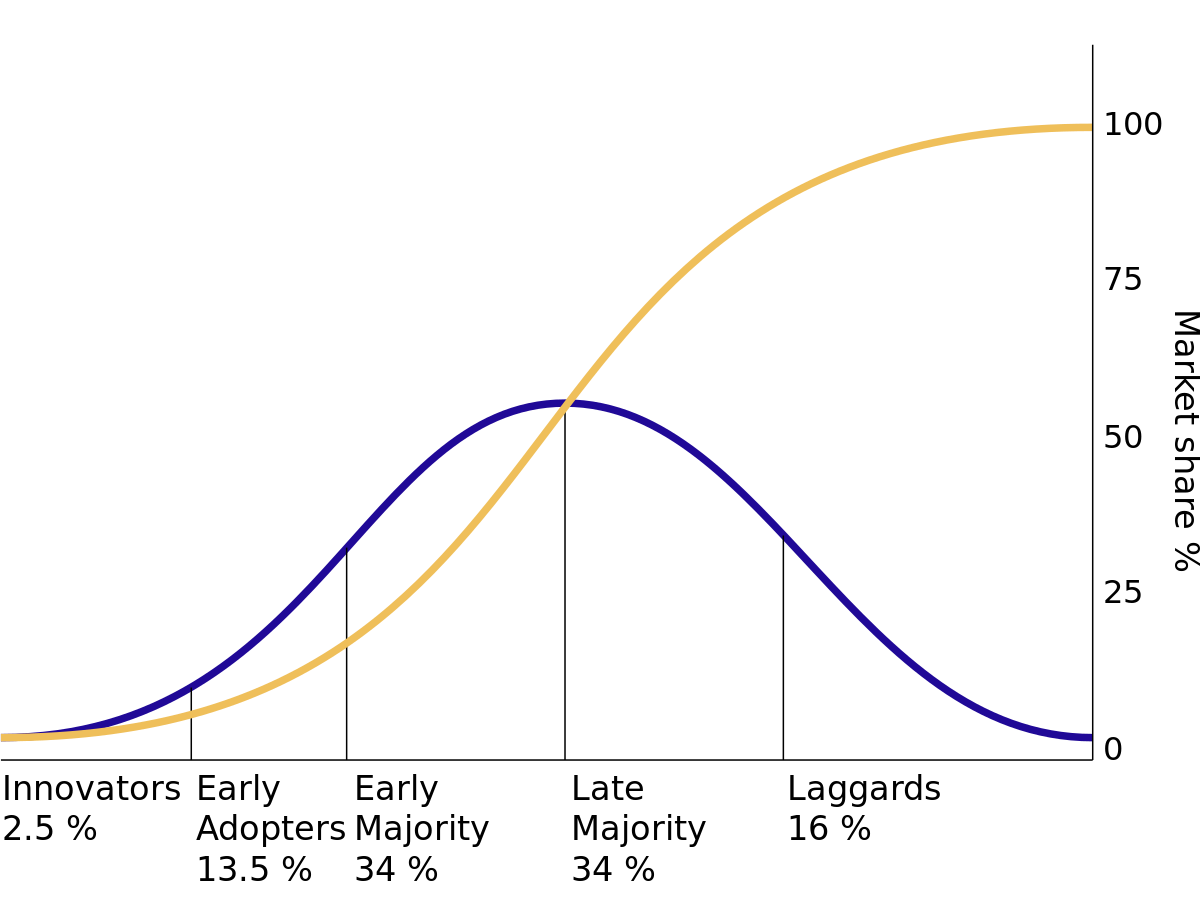 The diffusion of innovations according to Rogers. The yellow sigmoid curve shows the adoption in numbers, while the blue shows the rate of adoption.
Where are we now?
That is the trillion-dollar question. Are we already part way up the curve? Is the adoption rate still accelerating? If we are only part way up the curve, then we can look forward to some great, new, and interesting tools and time-saving devices in the near future. In much the same way as tools such as the web, and Google search helped us find and access information, ChatGPT and other LLMs (Large Language Models) are opening up a whole new world of possibilities and making information more accessible to the masses. One important thing to keep in mind, is that at the moment these tools are publicly available for testing/demonstration purposes. What happens when this gets locked behind a paywall? It has taken a considerable amount of time for internet to be accessible to those it is now accessible to, how long will it take for these LLMs to be accessible? How many billions of people will be disadvantaged in the meantime?
If we are only at the beginning, then we have only a limited understanding and scope to predict where we will be in just a few years' time. Google search may now be heading down the same path as Yahoo. With the showcase of their answer to ChatGPT, Bard, failing spectacularly during a public demonstration, the share price dropped 10% overnight (that's over $100 billion USD in a single hit). Will Bing be the new Google? How many other competitors will there be in the space even by the end of the year? In much the same way as we made predictions about the internet in the 1990s, we cannot comprehend how far this will take us, or how many new problems we may be creating for us in the future. One of my biggest concerns at the moment is that we may have just stumbled into the Library of Babel – a technology that was designed to help us find and process information will instead produce data-based grey goo – how will we ever find the information we can currently find now?
This piece will remain here as a snapshot for the future. I will leave it with a quote from Karl Pilkington (who I consider to be one of the greatest philosophers of our time):
"A problem solved, is a problem caused."